When normality returns one sees Jeddah’s wayport future
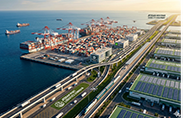 Long before America’s east coast ports were dredged deep enough to welcome mega-ships on the Asia–Europe route, shipping lines had already devised a workaround. Long before America’s east coast ports were dredged deep enough to welcome mega-ships on the Asia–Europe route, shipping lines had already devised a workaround.
The concept was “wayporting”: vessels too large for shallow US eastern harbors would discharge US-bound cargo at Mediterranean hubs such as Gioia Tauro or Algeciras. From there, smaller feeder ships carried containers across the Atlantic to consumer-rich hinterlands east of the Mississippi.
That workaround has faded in importance as US ports modernised, but the logic of wayporting is re-emerging in a different geography. Under Saudi Arabia’s Vision 2030, the Red Sea port of Jeddah is being positioned as a pivotal hub, linking Asia–Europe trade flows with inland connections to the Persian Gulf.
In an era of mega-ship overcapacity and renewed interest in eco-friendly feeders, the hub-and-spoke model is staging a comeback. Jeddah, with its strategic location and new infrastructure, could become the linchpin of this revival.
The most tangible sign of this ambition is the partnership between Maersk’s global port operator APM Terminals and Dubai’s DP World at Jeddah Islamic Port’s Southern Container Terminal. DP World holds a majority stake, but APMT’s 37.5 per cent share signals more than a routine concession. It is a bet by two of the world’s largest container operators that Jeddah can evolve into a true wayport - one that integrates sea–rail logistics and makes commercial sense.
The key enabler is the Saudi Landbridge Project, a rail line linking Jeddah to Riyadh and onward to Dammam and Jubail. Primarily designed for freight but also offering passenger service, the Landbridge promises to slash transit times and position Saudi Arabia as a logistics hub between Asia and Europe. Some sections are under development, though the Jeddah–Riyadh segment has yet to see full construction. Still, the intent is clear: to knit together Red Sea and Gulf trade flows, bypassing chokepoints and serving consumer-rich markets.
This is not just about infrastructure. It reflects a broader shift in global trade. The pre-Covid consensus that unrestricted free trade was the cure-all for economic growth has been tempered. The pandemic, coupled with geopolitical tensions, exposed vulnerabilities in supply chains. Western economies are retreating into defensible parameters, reshoring production of critical goods and limiting reliance on adversarial sources. The United States leads this retrenchment, with Europe following more reluctantly.
For shipping, this means fewer goods flowing to America and Europe, as they rebuild domestic capacity in industries ranging from footwear to shipbuilding. The era of endlessly rising transpacific and Asia–Europe volumes is over. To keep mega-ships full, carriers must think differently. Wayporting through Jeddah offers one such solution: redirecting flows toward Gulf markets that are wealthy, growing, and eager for consumer goods.
The Gulf states are not only rich in hydrocarbons but increasingly consumer-driven. Populations are young, urban, and digitally connected. Retail demand is rising, from luxury goods to everyday staples. Linking Jeddah to these markets by rail creates a seamless corridor, avoiding the Strait of Hormuz and its geopolitical risks while tapping into a region with purchasing power to spare.
There is also a demographic dividend. The United Nations’ Millennium Development Goal of halving extreme poverty was achieved five years ahead of schedule, in 2010. Millions who were once poor are now paying customers, particularly across Asia and Africa. As China’s role as the world’s factory diminishes, ASEAN trade lanes are yielding profits as never before. Belt and Road infrastructure, often dismissed as geopolitical theatre, is proving useful in connecting inland producers to domestic and overseas markets.
In this context, Jeddah’s wayport potential is not a relic of past shipping workarounds but a forward-looking strategy. It aligns with the reality that global trade is fragmenting into regional blocs. The West is divided, with one camp clinging to the old order and another pushing for protectionism and self-reliance. Whatever the politics, the practical outcome is less reliance on long-haul Asia–Europe routes and more emphasis on regional connectivity.
Shipping lines cannot expect to “to and fro” across oceans with the same profitability as before. Filling mega-ships will require creative routing, diversified markets, and infrastructure that shortens transit times. Jeddah, backed by Maersk and DP World, offers precisely that. It is a hub that can serve Asia–Europe flows while feeding Gulf demand, a wayport that makes geographic and commercial sense.
The stakes are high. If Saudi Arabia delivers on the Landbridge, it will not only transform its own economy but reshape trade patterns across the region. Jeddah could become the Gioia Tauro of the Red Sea—except with a hinterland far richer and more dynamic than southern Europe ever was.
For the shipping industry, the lesson is clear: adapt to new realities. The golden age of free trade is over, but new opportunities are emerging in places once considered peripheral. Jeddah is one of them. Wayporting there is not just a revival of an old idea; it is a blueprint for the next decade of global logistics. |