Black Sea shipping copes with war and the Middle Corridor
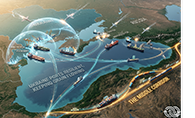 Ukraine’s ports - Odesa, Chornomorsk and Pivdennyi - have been repeatedly struck by Russian drones and missiles, yet they remain operational thanks to rapid repairs and international pressure to keep grain flowing. Ukraine’s ports - Odesa, Chornomorsk and Pivdennyi - have been repeatedly struck by Russian drones and missiles, yet they remain operational thanks to rapid repairs and international pressure to keep grain flowing.
Russia’s Novorossiysk, Tuapse, and Temryuk handle oil, wheat, and fertilizers, but they too have been disrupted by Ukrainian drone strikes.
Both sides calibrate their attacks carefully, inflicting damage without collapsing exports entirely, aware that grain and energy flows are politically sensitive commodities. This uneasy balance keeps Black Sea shipping alive, but precarious.
For Ukraine, the stakes are existential. Grain exports are not just an economic pillar but a diplomatic lever. By maintaining shipments through its humanitarian corridor, Ukraine sustains ties with Africa and the Middle East, regions acutely dependent on Black Sea wheat.
Metals and fertilizers also move when conditions allow, but grain dominates. Russia, meanwhile, remains the world’s largest wheat exporter, and its oil shipments from Novorossiysk are vital to its economy.
The vulnerability of these ports underscores the fragility of maritime trade in wartime. Ukraine is more vulnerable to closure, but Russia cannot afford prolonged disruption either. There is no cartel arrangement between the two sides - only mutual dependence and global pressure to keep food and energy flowing.
This fragility has accelerated interest in alternatives, most notably the Middle Corridor—the Trans‑Caspian International Transport Route (TITR). With Russia’s Northern Corridor compromised by sanctions and the Suez Canal vulnerable to disruption, TITR offers a multimodal path that bypasses both.
Cargo moves by rail across Kazakhstan, ships across the Caspian to Azerbaijan, then by rail through Georgia to Black Sea ports such as Poti and Batumi. From there, vessels cross to Constanța in Romania, feeding into Europe’s “blue banana” industrial belt stretching from northern Italy through Germany to the Benelux.
For China, it is a hedge against maritime chokepoints; for Kazakhstan and Azerbaijan, a chance to monetize geography; for Europe, a strategic alternative that reduces dependence on Russian transit.
Yet the Middle Corridor infrastructure bottlenecks abound: limited port capacity on the Caspian, rail gauge differences between countries, and underdeveloped logistics hubs in Georgia and Romania. Transit times are shorter than the Suez route in theory, but delays and transshipment costs erode efficiency.
Insurance premiums remain high due to proximity to conflict zones. Like the Nicaraguan canal project that promised to rival Panama but never materialized, TITR risks becoming more aspirational than operational if financing and political coordination falter. It is a corridor of dreams, not yet a corridor of steel.
The comparison is instructive. The Nicaraguan canal was launched with fanfare, promising to rival Panama, but collapsed under the weight of politics and finance.
IMEC, the India–Middle East–Europe Economic Corridor, faces similar hurdles. TITR, too, may remain pie‑in‑the‑sky unless billions are invested and sovereignty issues resolved. Grand infrastructure projects often falter when confronted with the hard realities of geography and geopolitics.
The Middle Corridor may yet move forward, but until financing is secured and construction begins, it remains more statement than solution.
Meanwhile, Black Sea shipping soldiers on. Ukraine’s ports, damaged but repaired, continue to load grain. Russia’s Novorossiysk, scarred by drone strikes, continues to pump oil. Both sides know that shutting down exports entirely would trigger global backlash.
Food security in Africa and the Middle East, energy flows to Europe, and fertilizer supplies worldwide depend on these routes. The war has made shipping precarious, but it has not made it impossible. Adaptation is the order of the day.
In the end, the state of Black Sea shipping is defined by resilience under fire. Ukraine and Russia continue to export grain, oil, metals, and fertilizers despite attacks. The Middle Corridor offers promise but faces hurdles reminiscent of the Nicaraguan canal—grand in vision, fragile in execution.
Until infrastructure is built and financing secured, TITR is best understood as a geopolitical hedge rather than a logistical revolution. Black Sea shipping, battered but unbroken, remains the lifeline of Eurasian trade, while the Middle Corridor waits in the wings. |