IMEC: Corridor of Dreams or another Nicaraguan Canal?
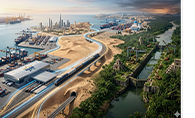 When the India–Middle East–Europe Economic Corridor (IMEC) was announced at the G20 Summit in New Delhi in September 2023, it was heralded as a bold new vision for global connectivity. When the India–Middle East–Europe Economic Corridor (IMEC) was announced at the G20 Summit in New Delhi in September 2023, it was heralded as a bold new vision for global connectivity.
The plan promised to link India’s west coast ports to the Gulf, cross the Arabian Peninsula by rail, traverse Jordan and Israel, and then connect to Greece and onward into Europe.
It was presented as a counterweight to China’s Belt and Road Initiative, a corridor that would diversify trade routes, reduce reliance on the Suez Canal, and knit together transport, energy, and digital infrastructure across continents.
Yet, more than two years later, IMEC remains more blueprint than bulldozer, more aspiration than action. The question is whether this corridor will ever move beyond glossy maps and political speeches - or whether it will join the ranks of grand but unrealized projects like the Nicaraguan canal.
The appeal of IMEC lies in its promise of resilience. The Suez Canal, through which roughly 12 per cent of global trade flows, has proven vulnerable to disruption, as the world learned during the Ever Given blockage in 2021. Rail and maritime diversification could, in theory, reduce exposure to chokepoints.
IMEC also carries the allure of geopolitics: India gains stature as a hub of Eurasian trade, Gulf states diversify their economies beyond oil, and Europe strengthens ties with partners outside China’s orbit.
For Washington, IMEC is a strategic hedge against Beijing’s Belt and Road, offering an alternative alignment of infrastructure and influence.
But the corridor’s weaknesses are glaring. Unlike the Suez Canal, which is governed by international treaties and has a century of operational history, IMEC would depend on the cooperation of multiple sovereign states—India, UAE, Saudi Arabia, Jordan, Israel, and Greece—each with its own political sensitivities.
Customs harmonization, security guarantees, and infrastructure standards would need to be negotiated across borders that have seen conflict and mistrust. The rail link through Saudi Arabia, Jordan, and Israel is particularly vulnerable to regional volatility. A corridor that depends on seamless cooperation among these states is, at best, fragile.
Financing is another unresolved issue. While India, Saudi Arabia, and the UAE are expected to provide seed capital, and the European Union has expressed interest through its Global Gateway initiative, no binding financial commitments have been announced.
Multilateral banks such as the World Bank or Asian Development Bank could play a role, and private investors like BlackRock have been mentioned, but the project remains unfunded. Without shovel-ready financing, IMEC risks becoming a diplomatic talking point rather than a construction site.
The comparison to the Nicaraguan canal is apt: that project, too, was launched with fanfare, promising to rival Panama, but it collapsed under the weight of political, financial, and environmental realities. IMEC could suffer the same fate if enthusiasm is not matched by investment.
Even if financing were secured, IMEC’s ability to rival the Suez Canal is questionable. The canal’s throughput dwarfs what rail freight could carry. Containerships moving through Suez handle volumes that no overland corridor could match.
At best, IMEC would complement Suez, offering diversification for certain flows—energy pipelines, fiber-optic cables, and high-value goods - but it cannot replace the canal’s role as a global artery. Analysts who tout IMEC as a Suez substitute risk overstating its potential. The corridor may reduce reliance on Suez in marginal ways, but the canal’s dominance will remain intact.
The geopolitical dimension complicates matters further. IMEC was conceived as a counterweight to China’s Belt and Road, but it is vulnerable to the same criticisms. By integrating transport, energy, and digital systems across borders, IMEC centralizes oversight in ways that could erode national sovereignty.
Critics like Patrick Wood argue that such corridors are less about trade efficiency and more about embedding nations into supranational frameworks that reduce autonomy. The corridor’s reliance on fiber-optic cables and energy pipelines raises questions about surveillance, control, and dependency. In this sense, IMEC may be less a rival to Belt and Road than a parallel manifestation of the same technocratic impulse.
The political volatility of the region adds another layer of uncertainty. Israel’s role in the corridor is particularly sensitive. Any disruption in its relations with Arab neighbors could derail the project.
Jordan’s economic fragility and Saudi Arabia’s balancing act between East and West also complicate matters. A corridor that depends on uninterrupted cooperation across these states is inherently vulnerable. Unlike the Suez Canal, which is a single sovereign project, IMEC is a patchwork of sovereignties stitched together by political will. That stitching could unravel quickly.
So where does this leave IMEC? At present, it is a vision in search of financing, a plan in search of stability, and a corridor in search of sovereignty. Its maps are compelling, its speeches persuasive, but its bulldozers remain idle.
The comparison to the Nicaraguan canal is not cynical; it is realistic. Grand infrastructure projects often falter when confronted with the hard realities of politics, finance, and geography. IMEC may yet move forward, but until financing is secured and sovereignty issues are resolved, it remains pie in the sky.
That does not mean IMEC is irrelevant. Even as a plan, it signals intent. It shows India’s ambition to play a larger role in Eurasian trade, the Gulf’s desire to diversify, and Europe’s interest in alternatives to China. It reflects Washington’s strategy to counter Beijing’s Belt and Road.
In this sense, IMEC is already shaping geopolitics, even if it never shapes concrete. But intent is not infrastructure. Without financing, treaties, and construction, IMEC risks becoming another entry in the long ledger of unrealized corridors.
In the end, IMEC is both dream and dilemma. It embodies the aspiration to diversify trade routes and reduce reliance on chokepoints, but it also exposes the fragility of multi-nation projects.
It promises resilience but delivers uncertainty. It is hailed as a rival to Suez but cannot match its scale. It is presented as shovel-ready but remains unfunded. Like the Nicaraguan canal, it may remain a monument to ambition rather than a functioning artery of commerce. Until the first rails are laid and the first ships dock, IMEC is best understood not as a corridor of steel and fiber but as a corridor of dreams. |