China freight train pulls into London from half a world away
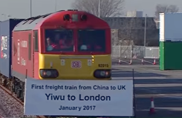 THE first China-UK freight train, from Yiwu, 100 miles southwest of Ningbo, to London, arrived after 18 days crossing China, Kazakhstan, Russia and Europe to discharge clothes, socks, shoes, bags, suitcases, wallets and household goods at Barking's Eurohub freight terminal. THE first China-UK freight train, from Yiwu, 100 miles southwest of Ningbo, to London, arrived after 18 days crossing China, Kazakhstan, Russia and Europe to discharge clothes, socks, shoes, bags, suitcases, wallets and household goods at Barking's Eurohub freight terminal.
With what most hope is an atypical low-value experimental cargo, the China and London rail route was thus inaugurated, marking another step in rail connectivity between Asia and Europe. This is said to be the beginning of a freight service that will alter trading patterns for land, air and sea.
The new rail route, which directly connects 16 cities in China with 15 in Europe will traverse Eurasia before entering the UK through the Channel Tunnel.
"The new service has a very quick transit time," said Brunel Project Cargo chief Mike White. "We believe this is going to change the way forwarders and shippers view their imports and exports for China."
But one should not mistake this for the four to five-day 6,800-kilometre rail journey across Canada with its two rival railways, along well maintained tracks of a single gauge and with uniform rules and regulations throughout.
In this case there is a lack of competition on the route, with national railways offering services and a single company, UTLC, managing tracks in the former Soviet CIS region.
France's Geodis and Germany's DB Schenker have been keen users, but and anyone can book their own train or book their boxes on one. Some companies were offering less than container load (LCL) services, but they appear to be experimental. So far, the China-Euro rail run is a mostly a block train business.
The 12,000 kilometre Yiwu-London run is fraught with border crossings, intermodal transfers from one set of rolling stock to another. This occurs at the Kazakhstan-Russian border and again at the Belarus-Polish border.
The UK is the eighth country and London the 15th city to be added to the company’s China - Europe rail network. The Chinese company’s UK agent is One Two Three Logistics, which is being supported by Brunel Project Cargo.
The inaugural demonstration trip is to be followed by regular weekly trains for three or four months to assess the market, reports the UK Railway Gazette.
List prices for delivering an FEU high cube box westbound is US$4,600 - half the price of air freight - while the eastbound backhaul rate is $2,500 for a 21-day transit.
The service is expected to be used by shippers of premium products such as automotive parts, electronics and food.
It would also offer a more cost-effective alternative to air freight for consignments that miss a ship’s departure date owing to manufacturing delays in China, but cannot be held back for another vessel.
The freight's first intermodal transfer takes place at the Khorgos Gateway dry port, whose CEO, Karl Gheysen said: "We now have two trains a day with 80 TEU and 41 containers per train. It runs three times a week to Duisburg, but we have also have services to the Netherlands, Madrid, Iran and now the UK." Capacity is 540,000 TEU a year, which can easily rise to a million, he said.
Khorgos Gateway was built by the Kazakhstan government where the rail gauge changes, which makes it a good point for transshipment. There are now some 10 rail lines from Khorgos Gateway, opening many options around Europe, the CIS and Asia, he said.
Forwarders are increasingly using the service, while DHL has plans to build warehouses for its customers at Khorgos.
"Its real advantage is 15 days transit over 45 days for sea freight," said Mr Gheysen. "And exports are starting - and we have requests for backhaul now."
Until June 2016, there had been 1,881 headhaul services from China to Europe and 502 backhaul runs. Backhaul cargo included German machinery, meat products, Russian woods and French wine.
Some say rail could take 10 per cent of sea freight but Mr Gheysen doubts that, saying it would take three to five per cent at best. "Air freight will be more affected than ocean shipping," he said.
Hewlett-Packard (HP) was one of the first shippers to use the service and now accounts for 30-40 per cent of its total throughput.
Mr Gheysen said rail advantage over sea freight was not just a matter of transit time. HP manufactures at Chongqing more than 1,000 kilometres from a seaport. If inventory costs during transport, as well as first and final mile costs were added, sea freight becomes more costly, especially for high-end goods.
At first the service was hampered by extreme weather conditions in winter for which they were unprepared. Mr Gheysen also revealed that Toyota had tested it for car transport, but found that the viscosity of brake fluid changed in sub-zero weather conditions. In response, the Kazakh government invested in more than 1,000 temperature controlled containers, for both summer perishables and winter use.
The containers also have GPS monitoring, which reassures shippers with concerns over the security of the route.
One of 39 rail lines, Russian Railways, now claims to be developing a high-speed rail freight that can carry a full load of cargo at 300 kilometres per hour cutting transit to two days, says the BBC. That would divert cargo from containerships, should such a development come to pass.
Russian Railways president Oleg Belozerov said Russia would become the world leader in high-speed rail freight. "We plan to reach China via Kazakhstan and carry special, high-profit cargoes to Europe via Russia,” he said.
Mr Belozerov said a high-speed rail freight line could cut transit to two days - which in some instances is even faster than what is needed for air cargo.
While high-speed passenger trains have been rapidly covering Asia and Europe over the past decade and a half, high-speed cargo trains have not been keeping pace - and in some respects they are theoretical rather than practical.
Construction is set to begin later this year with $6.5 billion of loans and $1.6 billion in foreign direct investiment coming from China, while a German consortium led by Siemens, Deutsche Bank and Deutsche Bahn promise to invest over $2.8 billion. This new high speed line is to open in 2023.
Rail links along this route are the core component of China's One Belt, One Road strategy as it seeks to realise a modern-day reincarnation of a Sino-European Old Silk Road.
The UK's biggest supermarket, Tesco, didn't have any goods on the first London train, but does use rail to carry toys, electrical goods, homeware and clothing from China to European rail hubs in Bratislava in Slovakia and Krasnaje in Belarus, said Tesco logistics chief Alistair Lindsay.
Sino-European rail freight won't be for everyone. Time-sensitive material will still use air freight, though that method still costs twice as much. Far less time-sensitive material will use far cheaper containerships offering savings of 50 per cent, but takes 200 per cent longer to deliver.
But for expensive merchandise that needs quicker delivery, trans-Eurasian rail is becoming a real alternative to expensive air freight. Forbes magazine notes that some of those items include "electronics, fashion items, car parts, heavy machinery, premium agricultural goods and fresh meat".
There are other Asia-Europe rail routes in various stages of development, some being largely theoretical. The Trans-Asian Railway (TAR) is a project to create an integrated freight railway network across Europe and Asia. TAR is a project of the United Nations Economic and Social Commission for Asia and the Pacific (UNESCAP).
This project was initiated in the 1950s to provide a continuous a 14,080-kilometre rail link between Singapore and Istanbul with connections to Europe and Africa.
Progress in developing the TAR was hindered by political and economic obstacles throughout the 1960s, 1970s and early 1980s.
It was also seen as a way to improve the economies and accessibility of landlocked countries like Laos, Afghanistan, Mongolia, and the Central Asian republics. Much of the railway network already exists as part of the Eurasian Land Bridge, although some significant gaps remain.
The Southern Corridor would go from Europe to Southeast Asia, connecting Turkey, Iran, Pakistan, India, Bangladesh, Myanmar, and Thailand, with links to China's Yunnan province and, via Malaysia, to Singapore.
Gaps exist between India and Myanmar, between Myanmar and Thailand, between Thailand and Cambodia, between Cambodia and Vietnam and between Thailand and Yunnan. The section in eastern Iran between Bam and Zahedan has been completed.
The North-South Corridor would link Northern Europe to the Persian Gulf. The main route starts in Helsinki, Finland, and continues through Russia to the Caspian Sea.
The Trans-Asian Railway Network Agreement is an agreement signed on 10 November 2006, by 17 Asian nations as part of a United Nations Economic and Social Commission for Asia and the Pacific (UNESCAP) effort to build a transcontinental railway network between Europe and Pacific ports in China.
While these developments are not likely to materialise soon, they do give interested parties, from investors to railway buffs, something to think about how and when these largely theoretical projects will likely to materialise in the years to come.
|