Mediterranean dreams and schemes - Snatching Europe from northern ports
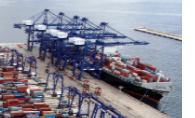 As consumer demand rises in Europe, the flow of goods from Asia to the EU may well shift in important ways - from air to rail and sea - or more strikingly from northern range ports to those in southern Europe. As consumer demand rises in Europe, the flow of goods from Asia to the EU may well shift in important ways - from air to rail and sea - or more strikingly from northern range ports to those in southern Europe.
Much is already happening though barely perceptible, glacial movement that will likely become massive as time goes on if statistical trends prove to be enduring, At which point it is likely to become a true game changer if oil prices rise to previous high levels.
Of course, much depends on the continued movement to better times. Should current trends endure, an improving global economy would involve greater use of Suez to reach West Africa and the east coast of North America. This trend would also accelerate the use of southern European ports as a widening gateway to the continent.
One can see today how the transport terrain has changed in recent years to produce an astonishing, but still largely unappreciated transformation in the way cargo is moved worldwide.
One could start with the young, but maturing, rail service from China to Europe - lately reaching London - which admittedly accounts for little volume today, but for high-end consumer electronics is fast enough westbound for the fashionable tech market and much cheaper than air. It is proving useful to move European machinery eastbound albeit to a lesser degree.
Then there is China's Belt and Road 2013 campaign, which while still patchy, stands to be a vital multi-deal maker, building bridges literally and figuratively, patching up road and rail links, thus forging what may yet become breath-taking connectivity in Asia and Africa.
Belt and Road stands to literally pave the way to new markets and through global trends of rising urbanistion, raising incomes in poorer countries. This is expected - certainly by China - to facilitate intra-African and intra-Asian trade as well as inter-continental trade on the grounds that the more trade there is, the more trade there will be, spawning new breeds of consumers in poorer countries moving up the value chain.
A third element which has not caught on as much as it will do, is the use of southern European ports. Ambitious port managers in Piraeus, Koper, Trieste, Venice, La Spezia, Genoa, Marseilles, Barcelona and Valencia, harbour dreams of becoming major gateways to Europe.
They seek nothing less than to supplant today's dominant, but counter-intuitive view that it is natural that Asian goods to be delivered to northern range ports from Le Havre to Hamburg, rather than the more obvious stretch between Greece and Spain.
This is not a new idea. Barcelona has been promoting it for 20 years. Why go around the Iberian Peninsula to land cargo in Europe when you can drop it off at southern European ports, and head right back to Asia?
Back then what looked like a good idea on the map, was made next to impossible because of differing rail gauges between the EU and Spain. While that has been fixed, it had to be admitted that road and rail connections were much better covering more densely populated consumer rich northern hinterland, as well as providing easier access to the UK, Russia, Scandinavia and the Baltic states.
But much has changed since, and much more change is in the offing. First, southern Europe is no longer the rustic backwater it once was. What was once viewed as a drawback, a sparsely populated region, is now seen as an asset that eases congestion and promises better cargo flow. Second, there is now considerable volume of transshipment containers bound for the east coast of North America and West Africa - and back again - which goes a long way to creating a critical mass to justify trade from an array of southern ports into Europe. Even little Koper in Slovenia boasts of a thriving trans-Med reefer trade from Egypt to augment its share in the new inflow for Asian cargo.
Today these ports harbour justifiable dreams and schemes as main gateways to southern, central and even northern Europe to include Milan, Venice, Genoa Vienna and Budapest. And who knows, even Paris, Munich, Antwerp, Rotterdam and Hamburg. The distance from Venice to Berlin is no more than New York to Cleveland and Marseille to Paris is only a little more than that.
Of course habits die hard and the northern range ports are tops in automation and have first class road and rail links. So despite some obvious geographic advantages, the northern ports still trump southern rivals, it even with their awkward routing around the Iberian Peninsula.
But if there were to be a big increase in the price of oil all that would change. That will bring in a whole new set of costs to European shipping that would not bode well for northern range ports - now that low-sulphur fuel rules are in place.
One only need recall the months before the low sulphur fuel rule was imposed January 1, 2015, that would have driven up costs to the breaking point that at least one English Channel North Sea ferry service expected to go out of business, the clean fuel cost 40 per cent more than standard bunker.
But before the rule was fully applied in the Baltic, the North Sea and the English Channel, the bottom fell out of the oil market. And cost of low sulphur fuel was even slightly less than what standard heavy bunker had been, so screaming protests fell silent and life went on as usual.
But had oil stayed high, it would difficult to imagine the old trade from St Petersburg to Montreal surviving. The Canadian city's hinterland, by virtue of its two Class I railways, includes New York. Toronto, Chicago and everything in between. But the ship connection would be saddled with costly low-sulphur fuel use from the eastern end of the Gulf of Finland to the Baltic Sea, then into the North Sea and from one end to the English Channel to the other before being free to use standard bunker again, but only briefly when crossing the Atlantic before it reached 200 miles off Newfoundland and once again in the clutches or regulators, all the way down the St Lawrence River to Montreal, 1,000 miles from the sea.
Sweden's port of Gottenburg intended to game the new rules, figuring that the low-sulphur regulation would make back-haul dead-heading north to Baltic lumber ports uneconomical for ships if they only had forest product cargo to bring back one way. Once they got the cargo, the ships were free to go anywhere that wanted their lumber. Gottenburg preferred to have it all, not only for Ikea, which makes its home there, but to export it to the world. Ships putting into that Atlantic port need only go through 200 miles of Emissions Control area to Gottenburg. So the scheme was to rail the lumber diagonally across Sweden to the port, providing Ikea, the big local industry, with a sweetheart deal, being first to buy the lumber at a competitive price, its principal raw material. But when oil prices plummeted, so did the scheme.
If low oil is not the new normal, but an only weird market fluctuation, and the price goes up to all time highs, screamers will return in force. And Europe's southern waterfront, which is already pitching itself as the European gateway of tomorrow will have something to sell, without having to make the ironic claim that they are protected by Muslim terrorists who keep European regulators at bay.
A better argument in their quiver will be statistics how their container traffic is enjoying double-digit growth (Barcelona up 14 per cent, Marseilles up 26 per cent and Piraeus up 14 per cent) while the northern range growth is slowing, and that seems to be a compensation for shrinkage suffered by others (Le Havre up 0.7 per cent, Antwerp up 4 per cent. Rotterdam, down 0.4 per cent and Hamburg, up 1 per cent).
Such statistics hint at the way forward. Marseilles is not waiting, and is to spend US$424 million on bid to be top Asia-Europe gateway, having announced it plans to boost annual throughput 11 per cent to 86.5 million tonnes by 2018. At the other end of the Mediterranean, the Cosco-owned Greek port of Piraeus has similar plans to make continental Europe its natural hinterland and it is not hard to imagine that other southern European ports will be ready to join them to win their own market share. |